
There are ideas that make complete sense in a deck and still feel slightly theoretical until actual people walk into the room.
Our first retreat experience was one of those ideas.
Before it became Spark, we called it the Vitality Retreat. The premise was simple: create a beautiful half-day experience where people could step away from their phones, move their bodies, learn something useful, spend time with other people, and leave feeling like the day had given something back to them.
I had been thinking for a long time about how much modern wellness happens alone. We track our own numbers, listen to our own headphones, follow our own routines, and move through plenty of health experiences without speaking to another person. I wanted to see what happened when wellness became social, tactile, and local.
Albion Garden in Los Angeles gave us the right setting to test the idea.
The setting mattered more than I expected
Albion Garden has the kind of atmosphere that makes you slow down when you walk in. There is natural light, Japanese-inspired design, a courtyard that feels tucked away from Los Angeles even though you are still very much in the city, and enough beauty in the details that the space does some of the work for you.
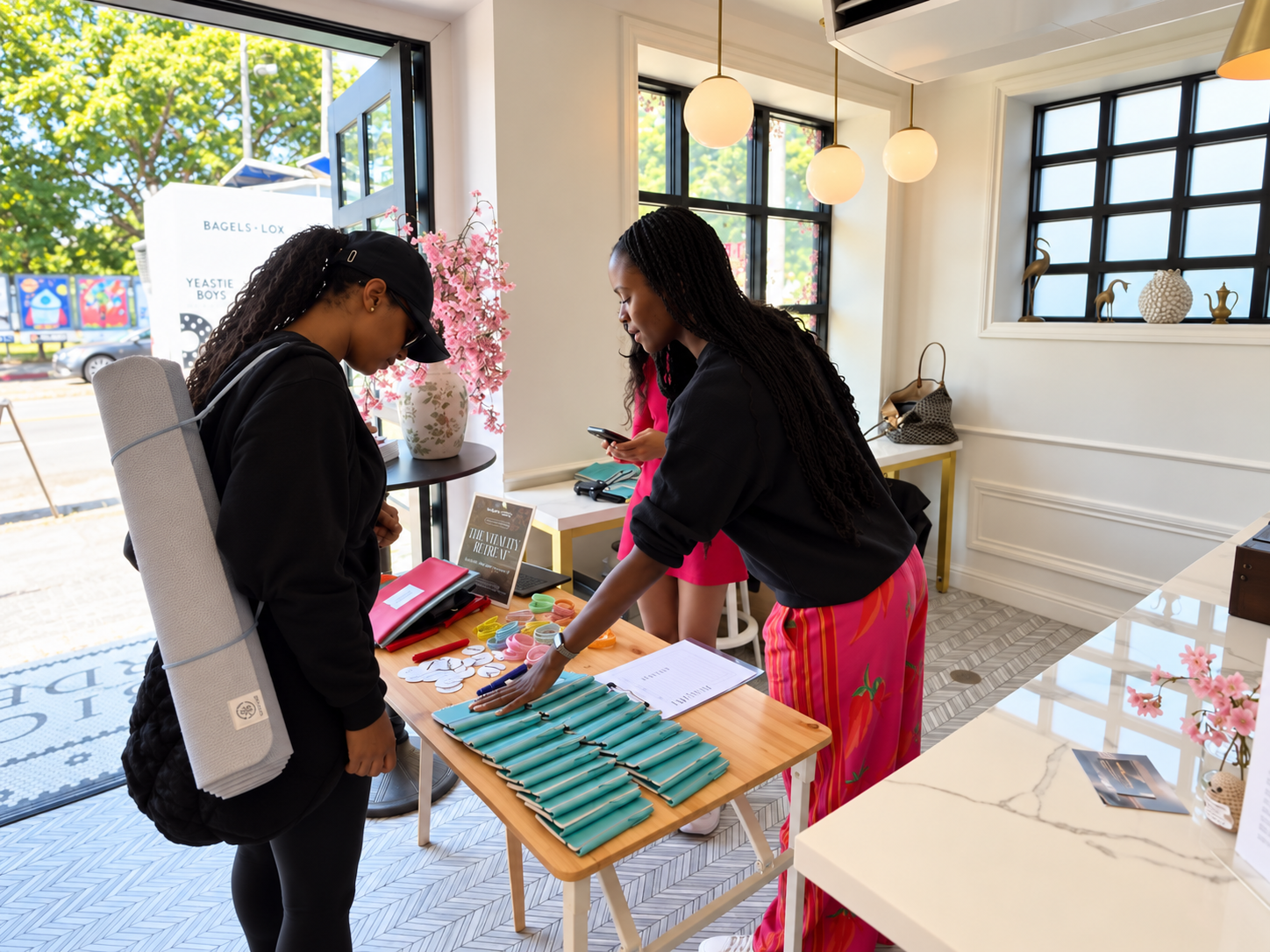
We set up WellZest journals, welcome materials, small objects people could use throughout the day, and a flow that moved between the indoor and outdoor spaces. Guests arrived, checked in, and had a chance to land before the programming began.
That word, land, became important. Most of us arrive everywhere carrying the thing we were doing five minutes earlier. We walk into a workout thinking about an email. We sit down for lunch while still texting. We arrive at a friend’s house mentally finishing work.
A good event has to help people cross a threshold.
For us, part of that threshold was putting phones away. It changed the room almost immediately.
Movement became the first point of connection
The retreat included movement programming designed to help people get into their bodies without turning the morning into a performance test.
There is something useful about moving in a group, especially when the experience is welcoming enough for people with different fitness levels. Research on group exercise has found benefits for quality of life and social support in several populations, and community-based activity can also create repeated opportunities for connection.
Our version was much more experiential than clinical. People stretched, moved, laughed, adjusted, and looked around at the other people doing the same thing.
That matters because shared activity changes the social temperature of a room.
A room begins to feel different once people have done something together. Conversation becomes easier after you have all been slightly awkward in the same movement sequence. The social temperature rises without anyone having to announce a networking exercise.
We wanted learning without turning the day into a conference
One of the challenges with wellness events is information overload. There are endless things people could learn about nutrition, stress, sleep, movement, hormones, mindfulness, recovery, and longevity. Put too much of that into one day and the event becomes another place where people are asked to absorb and perform.
We wanted the learning to feel conversational.
The retreat included experts and guides, including Mark Landsman and Ariel Hoffman, who brought their perspectives into a day designed around actual experience. We made room for movement, mindfulness, and moments where people could simply be in the space.
Matcha became part of the rhythm too, which sounds small, but food and drink have a way of turning programming into hospitality. A cup in your hand changes the energy of a conversation. Sitting down together changes the pace.
That is the part I keep returning to as we build Spark: the best wellness programming should feel generous.
The phone-free piece was the real experiment
I knew I wanted people to put their phones away. I was surprised by how quickly I noticed the difference.
Without phones constantly appearing, people looked at one another more. They stayed in conversations longer. They noticed the space. They were less likely to disappear mentally between programmed moments.
This is anecdotal, of course, but it aligns with the reason I care about social connection in the first place. The World Health Organization’s Commission on Social Connection has argued that loneliness and social isolation deserve much more serious public-health attention. Their 2025 report estimated that roughly one in six people worldwide experiences loneliness.
We cannot solve a public-health issue with one beautiful afternoon in Los Angeles. We can design more places where connection has a chance to happen.
That feels like a worthwhile place to start.
What we learned from the first retreat
The biggest lesson was how much people appreciated room in the schedule. A thoughtful environment, strong facilitation, good pacing, and enough space to actually experience what was happening mattered more than packing in another session.
I also learned that beauty matters when it supports the experience. The flowers, the journals, the courtyard, the way the room was set up, the food and drink, and the details at check-in helped create a sense that the day was special. None of those elements needed to become fussy.
People also wanted more opportunities to connect. That became one of the clearest signals for where WellZest events should go next.
Vitality Retreat became Spark for a reason
The name changed because the concept got clearer.
Spark is about interruption in the best possible sense. It is a few hours that break the rhythm of a normal week and create enough space for something new to happen. You might try a new form of movement, meet someone interesting, learn about a ritual, eat something good, spend time somewhere beautiful, or rediscover how different a few hours can feel with your phone put away.
We are keeping the half-day format because it feels realistic. People have full lives. Restorative experiences can fit inside an ordinary week, sometimes in the span of a single afternoon.
The next versions of Spark will continue to change with the setting and theme. Some will be quieter. Some will be more creative. Some will involve food, sound, movement, craft, or cultural rituals. The common thread will be the feeling we saw at Albion Garden: people becoming more present as the day went on.
That first retreat gave us proof that the idea works in real life, which is the only kind of proof that really matters when you are building experiences for people.
I left Albion Garden thinking about how easy it is to underestimate a few good hours.
A half day can be enough time to change the pace, meet someone, learn something, make something, and return to your life with more energy than you brought in.
That is the spark we are building around now.