
I started my career in health and wellness, designing incentive programs for large companies and universities during the rise of healthcare consumerism. Employers were becoming increasingly interested in programs that could encourage workers to drink more water, walk more steps, go to the gym, complete health assessments, and generally behave in ways that looked healthier on a dashboard.
At the time, the logic was straightforward. Healthier employees could potentially mean lower healthcare costs, fewer missed days, and better productivity. I dutifully built complicated programs around that premise, and plenty of the behaviors we encouraged were genuinely useful. Walking, preventive care, movement, and sleep all matter.
The part I struggled with was the environment surrounding the employee we were asking to make all of these changes.
I remember reading survey responses from people who were exhausted, understaffed, and working brutal schedules. They were being invited to join a walking challenge while trying to survive an eighty-hour week. I kept thinking that a day off, adequate staffing, a manageable workload, and enough time to eat lunch might do more for their well-being than another points-based wellness initiative.
Almost two decades later, I find myself asking a similar question about the wellness industry as a whole: have we become so fascinated by optimization that we are overlooking the ordinary conditions that make a human life feel healthy?
Wellness has become incredibly sophisticated
We are living through an extraordinary era of health innovation. Wearables can track sleep, heart rate, temperature, recovery, and activity around the clock. Personalized medicine is advancing. Longevity research has moved from niche corners of the internet into mainstream culture. Consumers have access to supplements, diagnostics, fitness platforms, AI-powered health guidance, and treatments that would have sounded futuristic twenty years ago.
I find much of this fascinating. Anyone who knows me knows that I am very capable of getting excited about a new treatment or trying some unusual wellness experience in another country. Curiosity is part of why WellZest exists.
I also think our fascination with sophisticated tools can make the simple questions feel almost unsophisticated by comparison.
How much are you sleeping? How much of your day is spent sitting? Do you have people you can call? Does your work leave enough energy for a life outside of it? Do you regularly spend time outdoors? Do you eat meals with other people? Do you have somewhere in your week that feels playful? Do you have time when nobody is asking anything from you?
Those questions are much harder to monetize, and they are much harder to solve with a single purchase.
Social health deserves a seat at the table
The World Health Organization’s 2025 Commission on Social Connection reported that roughly one in six people worldwide experiences loneliness. The report treats social connection as a public-health issue because relationships influence mental health, physical health, resilience, and longevity.
This is one of the reasons I find the individualization of wellness so interesting. Many modern wellness products are designed for a person to pursue health alone. You track your sleep alone, follow your personalized plan alone, complete your workout through your headphones, and receive recommendations calibrated specifically to you.
Personalization can be incredibly useful. Human beings also have an ancient need to belong to something larger than themselves.
Some of the moments when I have felt most well have been wildly unglamorous: eating with friends until the meal turned into hours of conversation, walking through a new city with no particular destination, laughing so hard during a group activity that I forgot to check my phone, or sitting outside after dinner with people I love.
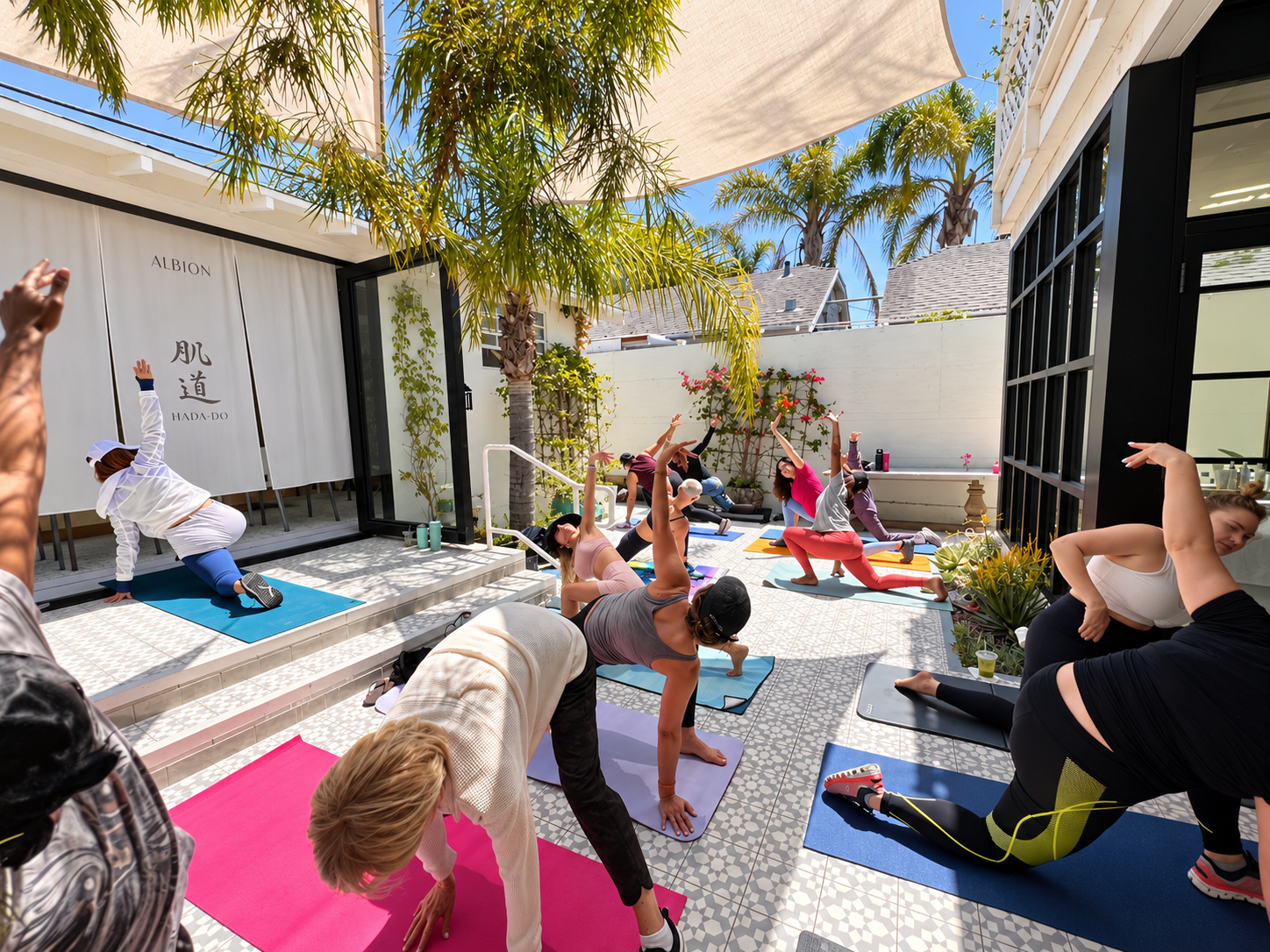
That is one reason the community piece of WellZest matters so much to me. At our original Vitality Retreat, which became the inspiration for Spark, people put down their phones, moved together, learned together, drank matcha, talked to strangers, and spent time in a beautiful setting. The atmosphere shifted because everyone was actually there.
We have engineered movement out of ordinary life
The second thing I keep thinking about is how sedentary modern life has become.
Many people wake up, sit in a car, sit at a desk, sit through virtual meetings, sit in traffic, then sit on the couch. Food arrives through an app. Groceries arrive through an app. Entertainment arrives through an app. Work arrives through a laptop. A person can complete an astonishing amount of life without traveling very far from a chair.
The CDC notes that physical activity has immediate benefits for sleep, anxiety, and blood pressure, along with long-term benefits for heart health, brain health, bone health, and chronic-disease risk. The recommendation to move more is familiar. The more interesting question is how to make movement feel woven into life again.
A forty-five-minute workout can be valuable, and I love a good Pilates class. I also think there is something powerful about living in a way that asks your body to move throughout the day: walking to lunch, taking stairs, carrying groceries, meeting a friend for a walk, standing while you talk on the phone, gardening, dancing, swimming, exploring a neighborhood.
The design of our communities plays a role here. The CDC’s work on activity-friendly communities emphasizes that connected sidewalks, safe routes, transit, and nearby destinations can make everyday movement easier. Health is partially shaped by architecture, transportation, work culture, and public space long before we make an individual decision about whether to exercise.
The wellness aesthetic has become its own product
There is also the image of wellness, which has become remarkably specific.
You know the visual language: matching sets, perfect matcha, glass skin, minimalist supplement organizers, pristine kitchens, beautifully designed studios, and a morning routine filmed in soft natural light. I appreciate beautiful things as much as anyone. The tension begins when we start confusing the look of wellness with the experience of being well.
Travel has made that distinction impossible for me to ignore. I have spent time in more than fifty countries and have seen people practice health, beauty, movement, rest, and community in ways that look very different from the dominant wellness aesthetic on social media. People gather outside, families share meals, neighbors know one another, cultural rituals create rhythm, and movement happens because life requires movement.
UNESCO’s work on intangible cultural heritage is a useful reminder that rituals and social practices carry identity, memory, and community. They often exist because people have practiced them together for generations. Their value cannot be reduced to how photogenic they are.
I want a bigger definition of living well
I remain optimistic about wellness because there is so much we are learning, and because people clearly care about feeling better. I want the industry to keep innovating. I want better diagnostics, smarter preventive care, more useful technology, and new ways to help people understand their bodies.
I also want us to remain interested in the ordinary architecture of a good life.
That means relationships that feel nourishing, work that leaves enough room to recover, regular movement, places to gather, adequate sleep, and time outdoors. It also means food that supports you and still tastes good, a sense of curiosity, moments of beauty, laughter, play, and enough quiet to hear yourself think.
Wellness gets more interesting when it expands to include the way we work, the way our cities are built, the people we spend time with, the rituals we inherit, and the amount of joy we allow into our days.
That is the plot I want to follow.